

Rethinking Delivery for Outcomes: Inside the System 1 and System 2 Model - Part Three

In Part One, we introduced the System 1 & System 2 model, a dual-track approach that enables speed, autonomy, and better outcomes in banking delivery. We explored how decoupling and clear boundaries create the conditions for pace without chaos and autonomy without isolation.
In Part Two, we unpacked the distinct missions of each system:
- System 2 as the enabler, building the foundations that let delivery teams operate safely and at scale.
- System 1 as the autonomous driver of customer value, moving fast when properly supported.
Now, in this third and final part of the series, we shift from theory to impact. We’ll look at:
- The measurable impact of the model on delivery speed, quality, and resilience
- Why communication and collaboration between the two systems is non-negotiable
- The mindset shift required for lasting change
- Practical ways to improve and evolve the model over time
System 1 & System 2 impacts on delivery
When the System 1 & System 2 models click into place, delivery shifts from a dependency laden struggle into a clear, outcome focused rhythm. The benefits show up not just in speed, but in quality, resilience and team energy.
At its best, System 2 accelerates delivery by giving System 1 teams “paved roads” reliable, reusable components and platforms that make onboarding fast and day-to-day delivery frictionless. As one team member put it “We can spin up new teams and have them delivered in days, not weeks, because the environment, guardrails, and templates are already there.”
In the early phases of a project, System 2 may need to rely on manual checks to catch pitfalls, but as maturity grows these are replaced with automated guardrails. The result: less waiting, more building.
On one Ikigai project, initial delays were avoided entirely by using AWS while core platform capabilities caught up, a reminder that speed can come from flexibility as well as structure. Striking the right balance is crucial: overly strict guardrails can hinder progress, while overly lenient ones may jeopardise quality and compliance.
Readiness in System 2 is essential. As one Ikigai leader noted: “If there’s a failure in a critical System 2 aspect like security, everything stops.”
Unlike System 1 issues; which are typically localised to a single team or product; System 2 failures can cascade across the organisation, halting delivery for everyone. This makes investment in System 2 reliability a strategic imperative.
While System 2 has the power to block all delivery, System 1 can also create drag often by over engineering or chasing non-essential features. As another Ikigai leader observed: “Sometimes, System 1 teams get caught up in building cool things that aren’t really needed right now.”
Keeping focus on business outcomes rather than output volume is critical to avoiding this trap.
The way the two systems interact evolves through the delivery lifecycle. In early stages, System 1 pushes for rapid delivery of prototypes and aims to produce rapid value. But as production nears, System 2 steps in strongly to ensure security, compliance, and operational stability. By post-launch, Both systems work together to maintain velocity while keeping failure rates low.
When this rhythm is in place, deployment frequency rises, lead times shorten, and teams operate with greater confidence in both their pace and quality.
The System 1 & System 2 model, when built and run well, has a transformative impact on delivery.
Communication, collaboration & mindset shift
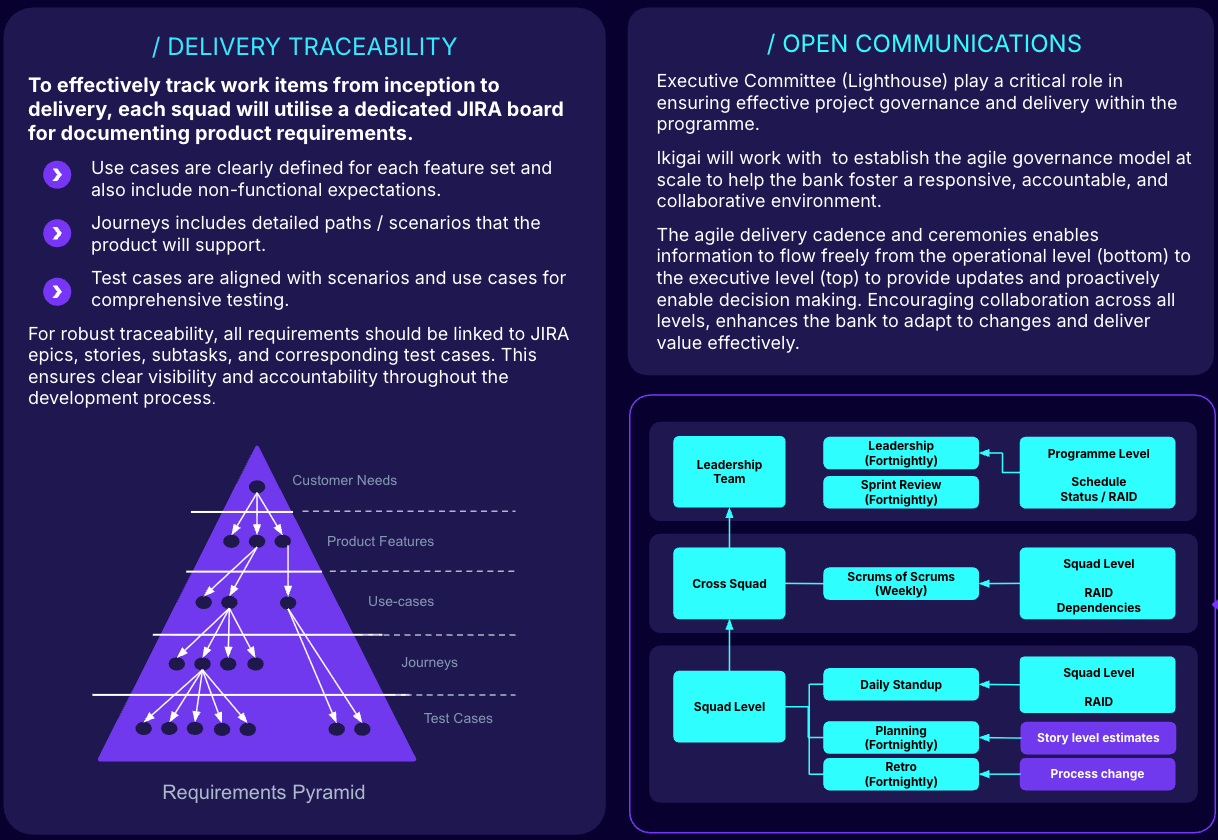
The System 1 & System 2 model only delivers its full value when both teams are aligned behind the same mission. This alignment isn’t just about shared goals on paper, it’s about constant, clear communication and a culture that values transparency over formality.
Shared vision builds accountability
The System 1 & System 2 model only works when both sides are truly aligned not just on process, but on vision and purpose. As one of Ikigai’s product managers explained: “A shared vision and understanding of launch phases fosters accountability across both System 1 and System 2.”
One engineering lead put it even more simply: “When we’re clear on the ‘why’ together, the ‘what’ and ‘how’ fall into place much faster.”
This shared vision extends beyond internal alignment. It also strengthens the relationship with clients. As one Ikigai leader said: “Clear messaging matters. You’re not just telling clients about two teams, you’re showing how those teams are aligned around the same outcome.”
Structured touchpoints & organic communication matter
Forums like guilds, architecture meetings, and cross-system syncs create space for shared decision-making and knowledge exchange. These structured forums are complemented by lighter weight channels; async Jira updates, Slack threads, and documented decisions; which help keep teams informed without drowning everyone in meetings.
“We found that cutting down on endless 1:1s and instead using async updates meant people stayed in the loop without burning half their week in Zoom”, said one delivery manager. A product manager echoed the point: “Our Jira setup means we can see what’s going on across teams without having to jump into a meeting every time. We prefer asynchronous communication as the primary mode for our remote team.”
This Organic communication also plays a critical role. While processes set the stage, real collaboration often happens in the flow of work: a quick message to unblock a dependency, a shared doc for instant feedback, or an impromptu huddle to resolve an architectural question.
For remote and distributed teams, this balance; alignment without overwhelming calendars; is essential.
Mindset shift
Ultimately, the most important change is not structural but cultural. Moving from a project-driven to a product-led approach transforms the relationship between System 1 and System 2. Instead of focusing on one-off deliveries, teams share accountability for long-term customer and business outcomes.
As one product manager put it:“The biggest change was moving from ‘our job is to ship this feature’ to ‘our job is to make this product succeed.’ That shift made us care much more about how the other system was doing, because their success was part of ours.”
When teams work this way, collaboration stops being a checkbox and becomes part of the delivery DNA enabling faster decisions, fewer misunderstandings, and a more resilient path to value. One engineering lead summed it up: “You can’t just drop the model in and expect it to work, you have to make a conscious decision to do it, with the right resourcing to actually build a platform people can use.”
While communication, collaboration, and a shared mindset are what make the model work in practice, they are not the end of the journey. Teams are quickly discovering that sustaining this alignment requires ongoing refinement.
How to improve the model
No operating model lands perfectly from day one. Teams spoke openly about learning through iteration, often refining their ways of working after moments of friction. While the model’s value was clear, interviewees pointed to areas where it could be strengthened.
Competing priorities and tight deadlines occasionally limit a team's ability to fully apply the system 1 and system 2 model, resulting in some natural gaps between intention and execution. However, these moments also highlighted the organisation’s adaptability. Teams can temporarily operate in a different system, based on practical constraints. As one Delivery Lead put it: “Our team is striving to become a System Two team by building a platform that empowers others to deliver features independently. For now, due to resource constraints driven by client priorities and the immediate need to deliver product features, the team is temporarily operating as a reluctant System One.
These challenges, while real, were seen as part of the journey. Teams emphasised that with a mindset of intentional adoption, short-term compromises need not derail long-term goals. There is the understanding that the appropriate system 2 team will productionise the feature and embed best practice.
Ikigai Interviewees also highlighted ways the model could be made stronger:
- a more intentional rollout,
- supported by clear internal messaging,
- consistent reinforcement from leadership,
- flexibility to adapt to different team cultures and maturity levels.
Summary: From Model to Measurable Outcomes
Across this three-part series, we’ve explored what it really takes to modernise banking delivery without sacrificing speed, safety, or sustainability.
In Part One, we introduced the System 1 & System 2 model as a practical way to decouple delivery optimised for measurable outcomes. We explored how clear ownership, boundaries, and responsibilities create the conditions for autonomy without chaos, setting the foundation for sustainable modernisation.
In Part Two, we went deeper into execution, defining the distinct but interdependent missions of each system:
- System 1 as the autonomous driver of customer value, able to move fast because the foundations are already in place, and
- System 2 as the enabler, building secure, scalable platforms and guardrails
In Part Two, we went deeper into execution, defining the distinct but interdependent missions of each system. We explored how System 2 teams “pave the road” by building the platforms, guardrails, and capabilities that allow System 1 teams to thrive, demonstrating what real autonomy looks like in practice.
In Part Three, we shifted from theory to reality, examining the measurable impact of the model on delivery speed, quality, and resilience. We explored why communication and collaboration between the systems are non-negotiable, why mindset matters more than structure, and how teams evolve the model over time to meet real-world constraints.
The takeaway is clear: the System 1 & System 2 model is not a framework to be “implemented and forgotten.” It’s a deliberate operating choice. When adopted with intent, supported by strong platforms, and reinforced through leadership and culture, it becomes a powerful accelerator for sustainable banking transformation.
At Ikigai, we work with banks and fintechs to design, build, and embed delivery models like this in practice. Whether you’re launching a greenfield bank, modernising a core platform, or struggling to balance speed with control, we help teams turn delivery ambition into repeatable outcomes.
Start building a better bank

